
Only 2% of CHROs think their performance management system works, according to Gallup. Too many organizations rely exclusively on annual performance reviews, and treat these reviews as evaluations rather than checkpoints—a bar for employees to clear rather than an opportunity to support them. That’s why HR teams are shifting to continuous performance management.
Continuous performance management is an ongoing system of check-ins, regular feedback, and goal tracking. Instead of employees getting a single meeting a year to know how they’re performing, they get consistent support from managers and leaders. Managers get more context on what employees are doing, employees don’t get blindsided once a year, and every check-in is a useful conversation instead of a memory exercise.
Continuous performance management is both a cultural shift and a structural fix. It means building a blameless culture of support rather than punishment, while fixing visibility issues and improving the way you measure performance.
Key Takeaways
- Continuous performance management treats performance as a living process, not an annual snapshot
- Its core components are regular check-ins, goal tracking, continuous feedback, structured 1:1s, and reviews that synthesize rather than surprise
- Managers do better work when they have current context; the whole system is designed to give them that
- AI makes continuous performance management more practical to run at scale
What is continuous performance management?
Performance management is a process used to define, measure, analyze, and report on employee performance. In many organizations, performance management begins and ends with annual reviews. At best, an employee might get quarterly reviews. Continuous performance management changes that. Instead of infrequent performance reviews, continuous performance management creates ongoing touchpoints between managers and employees to align on performance throughout the year.
Examples of these touchpoints include:
- Weekly or biweekly check-ins: These check-ins are usually done asynchronously, through a chat app or a performance management tool. Employees will answer a few questions, and managers can review these answers to get a sense of what they’re working on, where they’re blocked, and what issues they’re running into.
- OKR tracking: OKRs (Objectives and Key Results) allow employees to set clear goals for themselves that balance contributions to broader objectives and personal priorities. By setting and measuring them, managers and employees alike can manage performance consistently.
- Continuous feedback: This process gives managers and employees alike more opportunities to share feedback, whether that’s in meetings or through asynchronous means like quick check-ins and surveys.
- Regular 1:1s: 1:1 meetings bring employees and managers together, usually weekly or monthly. In these meetings, managers can review goals, listen to an employee’s concerns, and coach them through any issues they’re dealing with.
- Performance reviews: Performance reviews are still important in continuous performance management, usually as an official touchpoint for conversations around promotions and performance metrics.
The goal of continuous performance management isn’t to replace the annual review. It’s to supplement it with regular check-ins and eliminate surprises. Managers and employees can share a real-time view of performance and progress towards objectives rather than being in the dark 11 months out of the year.
How it differs from traditional performance management
Traditional performance management has two main problems: surprise and gaps. When managers and employees only have a few conversations around performance each year, there are bound to be surprises in every performance review.
Employees work towards unclear expectations, meaning they might build skills or work towards priorities their managers don’t expect. At the performance review, the manager asks an employee about their progress towards specific objectives, only for the employee to admit they worked towards different priorities. Or, the employee reveals issues they’ve been struggling with for months.
The manager, having never heard of them, becomes frustrated since they might have been able to support the employee and remove blockers. Because performance reviews are often stressful, high-impact conversations—affecting potential promotions and responsibilities—these surprises can lead to misunderstandings and conflict.
Continuous performance management can prevent these issues by giving employees and managers more touchpoints, keeping them aligned.
The element of surprise isn’t the only downside of traditional performance management. Yearly (or even quarterly) performance reviews create massive gaps in visibility and action, both for managers and employees. Managers and employees work together to set goals in a yearly performance review, then refer to these goals throughout the year.
But they never meet to discuss them or review their relevance unless they go out of their way to do so. Managers have no visibility into what employees are working towards year-round, while employees don’t get the feedback they need to stay on track.
The core components of continuous performance management
Continuous performance management creates multiple touchpoints for managers and employees beyond the yearly performance review. These touchpoints exist across multiple channels and can be either synchronous or asynchronous. Here are these core touchpoints.
Regular check-ins
Regular check-ins allow managers to take the pulse of how their teams are performing, the issues they’re dealing with, and the support they need. They can take a variety of forms, like the stand-up meeting popular in software development teams or automated chat messages that ask employees a few questions once a week (e.g., “what is your priority for next week?” or “where did you struggle this week?”).
These check-ins should be quick and easy, covering morale, blockers, and progress towards goals without deep reporting or back-and-forths.
Goal-setting and OKR tracking
Goals make day-to-day work more meaningful for employees and give managers more visibility into that work. But not all goals are created equal. OKRs (Objectives and Key Results) create a clear framework for building, managing, and tracking goals. They also naturally create alignment between individual goals and company priorities, since individual objectives trickle down from company objectives.
Some teams set OKRs once a year and revisit them once a quarter, while others set OKRs every quarter. Either way, ensure the cadence is the same across the organization.
Continuous feedback and recognition
Continuous feedback and recognition is a framework that gives employees and managers more opportunities to share their perspective and for employees to be recognized for their work. These opportunities might include adding more questions to 1:1 meetings, using regular check-ins to share feedback rather than just status updates, and having automated chat prompts for sharing feedback.
1:1 meetings
A 1:1 meeting is the ultimate touchpoint for managers and employees alike. Both parties can bring up their concerns, share feedback, and align on priorities for the coming weeks and months. In a culture of continuous performance management, 1:1 meetings are used to check in on goals, address potential performance issues, and offer support and coaching for employees.
Performance reviews as checkpoints
Performance reviews still have a role to play in continuous performance management. But instead of being a meeting that surfaces new information and potentially blindsides employees and managers alike, they are essentially a synthesis of every touchpoint you’ve had up to that point. The check-ins and goals you’ve tracked over the rest of the year become trends you can check in on and discuss. Performance reviews become alignment sessions instead of a box to check.
Why managers are the linchpin
HR might set the strategy, but managers are the ones putting it into practice. They’re the closest to the work, so they’re the ones who can give the most support, share the most feedback, and get the most visibility into what employees are working on. Most managers want to coach their employees over time rather than just have a single performance review a year, but they struggle to make the necessary time for this, use data correctly, and build a consistent process.
Managers can set up touchpoints throughout the year, but without the right context, it’s hard to know where they need to give support. The right tools put that context at their fingertips when they need it most.
That’s where 15Five’s Focus Briefs come in.
15Five is a performance management platform that can handle everything from employee engagement surveys to performance reviews and manager enablement. It also centralizes the data from all these initiatives, ensuring leaders and HR have better visibility into performance throughout the organization.
Focus Briefs enhance this by giving managers an AI-assisted weekly summary so they can start every week knowing what needs their attention, where their team is making progress, and where they should focus their support. AI handles the prep so managers can put more time towards the tasks that actually make a difference.
The role of AI in continuous performance management
AI is changing the way everyone works, and continuous performance management is no different. Historically, it was difficult for HR and managers to build processes that scaled effectively as teams grew. Manual tracking can only go so far, while email or chat-based feedback clogs communication channels rather than creating alignment. Tools like 15Five streamline this process, but its AI-Assisted Reviews completely transform it.
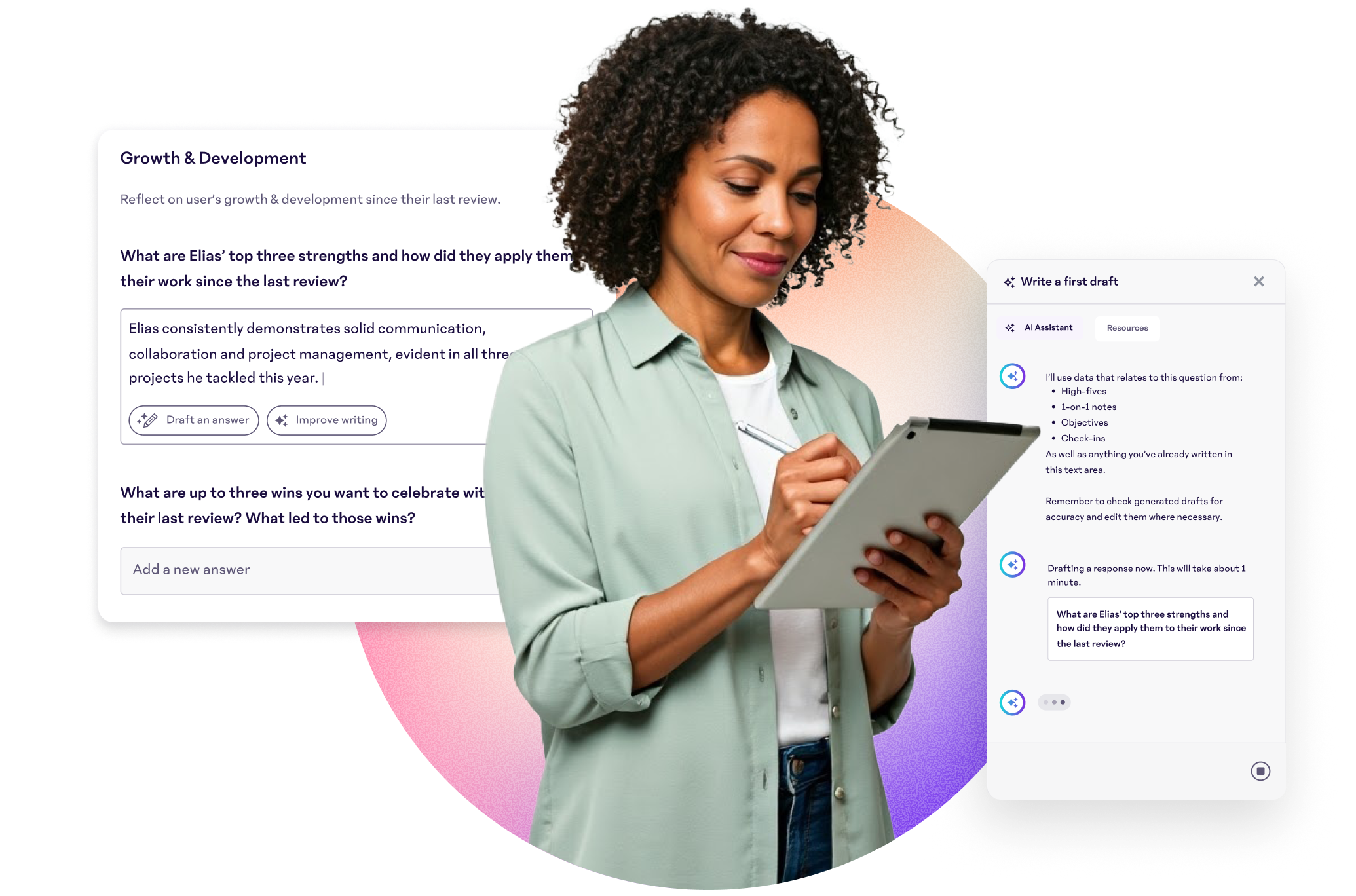
When a review cycle opens, managers don’t need to start from scratch or reconstruct months of performance conversations from memory. 15Five already brings together the data from goals, feedback, 1:1s, and Work Context in a single platform, but AI-Assisted Reviews draft these data points into a clear action plan for each performance review.
That leads to faster review cycles, stronger feedback, and better development conversations. All with one tool and a little help from AI.
How to get started
Here’s a step-by-step process every HR team can use to support managers in practicing continuous performance management.
Audit your current process
When do employees typically get feedback on their work? How do managers get visibility on an employee’s goals and progress towards them? Find out how many times managers and employees actually connect on performance every year, where performance data gets stored, and how it’s acted on.
Start with check-ins and 1:1s
Regular check-ins and 1:1s are the easiest touchpoints to implement and have the most ROI. A check-in can be as simple as setting up an automated message in your chat app of choice. A 1:1 is as simple as booking a meeting. Help managers build these habits by standardizing the way they’re used across teams.
Align goals across the organization
OKRs and similar frameworks allow individuals, teams, and leaders to build goals that are aligned both in strategy and format. That way, employees are more motivated as their day-to-day work contributes directly to organizational priorities, while leaders can make more strategic decisions based on inter-departmental work.
Invest in manager enablement
Managers are the frontline in continuous performance management, and they need support to make it happen. Performance management platforms like 15Five can automate much of the administrative work and reporting involved in continuous performance management. Similarly, clear frameworks and policies help managers build the right habits and meet expectations across teams.
Achieve continuous improvement
People and the work they do are always changing, and static performance reviews aren’t built for that constant change. Continuous performance management creates a more flexible process that supports employees and managers alike in finding alignment and doing their best work.
This requires intentional design, but not necessarily a complete overhaul. Most organizations are already using the touchpoints this framework needs (e.g., 1:1s, performance reviews). They just need to shift their approach so performance conversations become consistent coaching rather than a once-a-year surprise. Organizations that make this shift will see their managers get more effective, their employee engagement scores increase, and their employee retention improve.
Tools like 15Five’s Focus Briefs and AI-Assisted Reviews empower managers and HR alike in implementing these initiatives without adding a ton of administrative work to their already-full plates.
Want to see how? Get a demo of 15Five here.